
How to Get More Qualified Leads for Your Business
If you run a business in the US or UK and feel like your pipeline is full of the wrong people, you’re not imagining it. Generating leads is still one of marketers’ top reported challenges this year, according to HubSpot’s 2026 State of Marketing research — and the businesses winning right now aren’t chasing more leads. They’re chasing better ones.
That distinction matters because volume without fit drains your sales team’s time and your ad budget. If you want to get more qualified leads for your business, the fix isn’t a bigger funnel. It’s a tighter one — built around who actually buys from you, how you capture their attention, and how you track what’s working.
Why “More Leads” Isn’t the Same as “More Qualified Leads”
A qualified lead has two things going for it: they fit your ideal customer profile, and they’ve shown some real intent to buy — not just curiosity. A form fill from someone outside your service area or budget range counts as a lead in your CRM, but it doesn’t count toward revenue.
This is the gap that quietly drains marketing budgets. Teams celebrate falling cost-per-lead numbers, then six months later sales reports the pipeline is full of people who were never going to buy. The volume was there. The qualification wasn’t.
Fixing this starts before you spend a single dollar on ads or content. You need a written definition of what a qualified lead looks like for your business — industry, budget range, geography, and the buying triggers that signal someone is ready to move, not just browsing.
Step 1: Get Specific About Who You’re Targeting
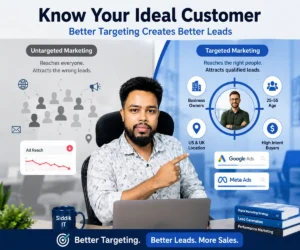
Vague targeting produces vague leads. If your messaging tries to speak to everyone, it resonates with no one strongly enough to convert.
Define your ideal customer with real detail: company size or household income, location, the specific problem they’re trying to solve, and what their buying timeline usually looks like. The tighter this profile is, the easier it becomes to write ads, landing pages, and content that filters out tire-kickers before they ever pick up the phone.
This is also where paid channels earn their budget back. A well-built Google Ads campaign targeting high-intent, commercial search terms brings in people who are actively looking to buy — not people researching general information. The same logic applies to Facebook Ads: audience filters and exclusions matter as much as the creative itself.
Step 2: Build Landing Pages That Qualify, Not Just Collect
Your landing page is doing two jobs at once: converting visitors and filtering out the ones who aren’t a fit. Most businesses only optimize for the first job.
A 2026 conversion-rate analysis from First Page Sage, drawn from B2B campaign data across dozens of industries, found that the most consistent lift came from reducing form fields for early-stage conversions and adding trust signals like client logos, review scores, and testimonials. The same report recommends including mid-page calls to action, since many visitors never scroll all the way down.
In practice, that means:
- Ask for only what you need at first contact (name, email, maybe company) — qualify further once you’re talking to them
- Show proof: case studies, results, recognizable client names
- Repeat your CTA more than once on longer pages
- Match the page’s message to the ad that brought the visitor there
A dedicated sales-focused landing page built around one specific offer will consistently out-convert a generic homepage, simply because it removes the guesswork for the visitor.
Step 3: Write Content That Filters as Well as It Attracts
Content marketing remains one of the most reliable ways to get more qualified leads for your business, but only when it’s built around buyer intent rather than broad keywords. The strategic shift in 2026 is toward intent alignment — addressing the specific pain points of your actual buyer at the stage they’re in, rather than optimizing purely for search volume.
This also lines up with how Google evaluates content quality. Google’s own Search Central documentation on people-first content advises creators to self-assess content through the lens of who created it, how it was made, and why — to align with the signals automated ranking systems reward. Thin, generic posts written to rank rather than help tend to attract clicks, not leads.
Practical filters to build into your content:
- Title and intro copy that names the specific problem your buyer has (this repels people who don’t have it)
- Case-style examples instead of abstract advice
- A clear next step at the end of every post — not just “contact us,” but a specific offer
If you’re not sure where your current content is leaking quality traffic without converting it, an advanced tracking and analytics setup will show you exactly where visitors drop off and which pages actually produce sales-ready inquiries.
Step 4: Score and Route Leads Before Sales Ever Sees Them
Not every lead deserves an immediate sales call. A simple scoring system — points for service-area match, budget alignment, urgency, and referral source — lets your team triage in seconds instead of guessing.
This doesn’t need to be sophisticated. Assign higher weight to behavioral signals (someone who requested a quote) than to passive ones (someone who downloaded a guide). The goal is a practical filter, not a complex algorithm — something anyone on your team can apply consistently.
Pairing this with creative that’s built to convert, not just look polished, matters too. Strong ad creative that speaks to a specific pain point consistently pulls in a more qualified audience than generic brand messaging, because it self-selects for relevance before the click even happens.
Step 5: Measure What Actually Predicts Revenue
Cost-per-lead is the easiest number to track and the least useful one on its own. Track these instead:
- Lead-to-opportunity rate (do your leads actually turn into real pipeline?)
- Time from inquiry to qualified conversation
- Revenue per channel, not just leads per channel
If a channel produces cheap leads that rarely become customers, it isn’t actually cheap — it’s expensive in sales hours. This is the kind of insight you only get with proper tracking and analytics in place from day one of a campaign, not bolted on afterward.
Frequently Asked Questions
How can a small business get more qualified leads without a big budget?
Start narrow. A tightly defined ideal customer profile, one well-built landing page, and a single paid channel run consistently will usually outperform a scattered approach across five channels with no qualification criteria.
What’s the difference between a lead and a qualified lead?
A lead is anyone who gave you contact information. A qualified lead fits your target customer profile and has shown a real signal of buying intent — a quote request, a pricing page visit, or a direct inquiry, not just a download.
How long does it take to start getting more qualified leads after changing strategy?
Landing page and targeting changes can show movement within a few weeks of consistent traffic. Content-driven and SEO-driven lead quality improvements typically take longer — often two to three months — to show a clear trend.
Should I focus on lead volume or lead quality first?
Quality. A smaller number of well-matched leads will produce more revenue, with less wasted sales time, than a larger number of unqualified ones — and it’s far easier to scale a system that’s already converting well.
Bringing It Together
Getting more qualified leads for your business isn’t one tactic — it’s a system where targeting, landing pages, content, scoring, and tracking all reinforce each other. Skip any one piece and the others have to work harder to compensate.
If you want a second set of eyes on where your current lead generation is leaking quality, take a look at our results or get in touch through our contact page — we’ll walk through what’s working in your funnel and what isn’t.